The Public Service after 1988 – change for the better?

24 October 2012 

Is it fad and folly or fact and foresight that motivates the interminable restructuring of New Zealand public sector agencies? This was one of many issues touched on by  Professor Jonathon Boston in his contribution to the ‘100 Year Perspective’  –  the IPANZ / Ministry of Culture and Heritage celebration of  enacting the Public Service Act in 1912. His paper, “the Eighties – A Retrospective View’’ explored aspirations for change and the spirit of reform that brought about refocused governance.  That new focus came from measures in the State-Owned Enterprises Act in 1986, followed by the State Sector Act in 1988, the Public Finance Act in 1989, and other legislation, concluding with the Crown Entities Act in 2004.

Substantial change was precipitated not only by economic circumstances, but by the alignment of reforming enthusiasm shared by Ministers in a new government and influential public service leaders.

Prof Boston acknowledged some advantages flowing from the reforms – which gave New Zealand poster child status among advocates of the new public management movement. New Zealand was the better for the changes but he recited a litany of overlooked opportunities and improvements ignored.  Some changes were more fad than foresight. A number of the strengths of 1912 Act were lost.

The post 1988 Public Service was quite different from the “old Public Service”, with agencies, arguably, having little in common.  What remained was a sense of service, of integrity and commitment despite the potential for cronyism and corruption.

Which raises the question of why Rt Hon Francis Maude, the British Cabinet Office Minister, is looking to New Zealand as a possible model of ways to increase the accountability and responsiveness of the civil service. In his reform plan released in June, he indicated a frustration with the civil service. He reiterated that frustration when appearing in July before the House of Lords Committee on the Constitution.

That led to the appointment of the Institute of Public Policy and Research to carry out a review of machinery of government in Australia, Singapore, New Zealand, United States and Sweden. The IPPR team will be in Wellington shortly as part of its fact finding. Mr Maude is also likely to make his own visit here shortly. It will be interesting to see what they identify in New Zealand arrangements that, if transplanted to Britain, would improve the performance of the civil service.

 Perhaps Professor Peter Hughes address next week on the 100 Year Perspective -“The Present and Future” will suggest answers.

Professor Lord Hennessy would be unlikely to concur. He said to the House of Lords Constitution Committee that …” I do not want to be unkind about New Zealand, but it is the size of a local authority. It is the square root of bugger all, really, compared to what Ministers in this country have to deal with, so I do not think it is much of a model…”


www.guardian.co.uk/public-leaders-network/blog/2012/aug/15/francis-maude-shrinking-civil-service?INTCMP=SRCH

www.cabinetoffice.gov.uk/news/government-first-use-contestable-policy-fund

www.parliament.uk/documents/lords-committees/constitution/CivilServ/ACSEvidenceFINAL.pdf

http://whitehallwatch.org/2012/10/04/reforming-the-senior-civil-service-what-do-you-think/
www.ipanz.org.nz/MainMenu

Chinese worry about inflation, contaminated food and corrupt officials

23 October 2012 

A Pew survey report released last week indicated that the Chinese have concerns not dissimilar to populations in the West. The side effects of development, rising prices, pollution, the gap between rich and poor and the loss of traditions worry many.  

Inflation remains the top concern. But half the survey participants say that corrupt officials are a major problem, up from 39% four years ago. Not surprising when Chinese media report that more 700,000 officials have been directed to take corruption training over the last decade. A propaganda chief , who would have been influential in the National Congress  which, next month, will confirm China’s new leadership, is in the news today, exposed as corrupt and implicated in a sex scandal.  

Even more dramatic than the concern about corruption is the fear of food contamination, illustrated of course by the of infant milk powder crisis several years ago. Worries about food safety  have increased more than three fold since 2008. 

Pew also reports that the Chinese are less assured of the role of their country in the world. Only 29% of Chinese thought their country was the leading world economy whereas 41% of American and 58% of British respondents thought China had that position.

www.pewglobal.org/2012/10/16/growing-concerns-in-china-about-inequality-corruption/

www.chinadaily.com.cn/opinion/2012-10/17/content_15823226.htm

http://chinadigitaltimes.net/2012/10/top-press-official-dismissed-amid-corruption-charge/

Customs PIF published

22 October 2012

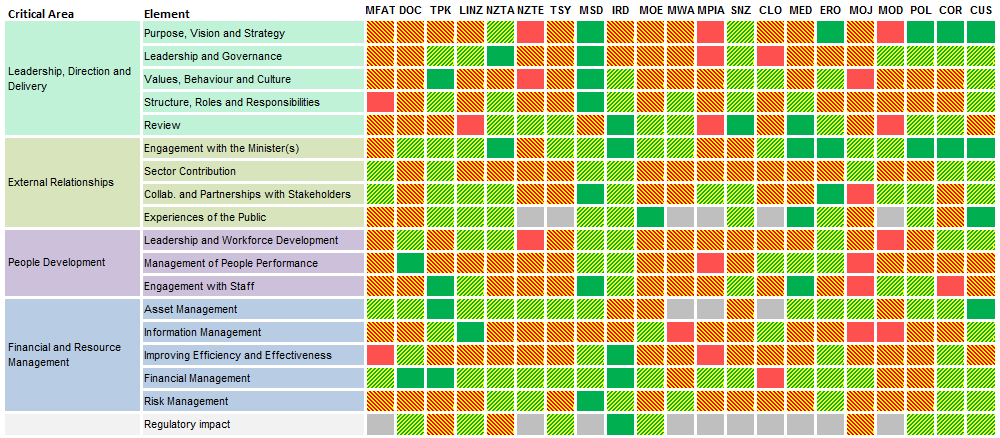
The performance improvement report on the New Zealand Customs Service was published last week. The report, the 21st in the series, ranks NZCS alongside the Ministry of Social Development and the Department of Inland Revenue as a performance leader.

The reviewers confirmed that the NZCS reputation for operational efficiency and effectiveness is well deserved; but in common with many other agencies, a weakness is in staff development.   

www.ssc.govt.nz/sites/all/files/pif-customs-review-oct12.PDF

www.ssc.govt.nz/sites/all/files/pif-factsheet5-21-reviews.PDF

The media seems only interested in leaked information

19 October 2012

What causes a Minister to make a call to arms, to invite the world’s media “…to hold the feet of government officials … squarely against the fire.”  The British Cabinet Office Minister who suggested this week that the feet of Ministers like himself should also be so treated, was criticising the reticence of the Civil service to implement open government commitments. But he also showed frustration that the media wasn’t using the information made available by an increasingly open government.

In the UK, agencies have published more than 8000 datasets in the expectation that media scrutiny will raise public awareness and improve the quality government. But the information seems to be largely unexplored.  The Minister called for journalists to investigate the information to hold the Government to account; to engage with the data “… to expose waste, incompetence and corruption wherever they see it.”

The Minister was marking the first anniversary of the Open Government Partnership which encourages good government through the accessibility of official information. He said that “…there’s nothing fluffy about transparency. It’s hard edged and demanding and serious … even when it gets uncomfortable you have to go through with it.”  The media doesn’t seem to share the Minister’s enthusiasm.

That attitude is mirrored by an almost uniform lack of enthusiasm among British agencies.  Many are releasing information in PDF format which precludes the manipulation and exploration of content. This disregards the Cabinet Office Minister’s commitment that spending data would be published in transparent formats. The Minister indicated that defaulting Departments “…will be dealt with”.

All of which suggests that agencies are “safe” to embrace the Official Information Act prescription of making information increasingly more available.  If large quantities of data are released, the media is neither interested nor capable of focusing  on anything in particular.  Wikileaks attests to that.

Ironically official data is in the news for different reasons in New Zealand.  The accessibility of personal information through kiosks in offices of the Ministry of Social Development in breach of privacy obligations, has stunned the Department which acquired a reputation of extreme risk management under a former chief executive. The incumbent, responsible for promoting the availability of information in his previous appointment as Government Chief Information Officer, is now “in the gun” for information mismanagement. His successor as the GCIO has been directed by the State Services Commissioner to survey system integrity across government. The champion of openness has now to ensure agencies are proper guardians of personal information.

www.guardian.co.uk/news/datablog/2012/oct/17/open-government-data-pdfs

www.kiwiblog.co.nz/2012/10/ng_reveals_massive_msd_privacy_breach.html

http://www.futuregov.asia/articles/2012/oct/16/nz-gov-plugs-security-gaps/?utm_medium=email&utm_campaign=FutureGov+Updates+205&utm_content=FutureGov+Updates+205+CID_84824d7881e2ff61453d8e31c6631d01&utm_source=Newsletter&utm_term=New%20Zealand%20gov%20plugs%20security%20gaps

Is “The Thick of It” the thin end of the wedge?

18 October 2012

The Thick of It is no longer just satire.  The Commons Public Administration Committee in a report on accountability titled “Special Advisers in the thick of it” has acknowledged that there is “…more than a grain of truth” in the BBC sequel to the Yes Minister and Yes Prime Minister series of programmes.

The Select Committee is concerned about the lack of transparency in the appointment of special advisers  – Spads – the UK equivalent of New Zealand’s ministerial advisers. The report indicates that the cross party Committee shares the concerns that were mentioned repeatedly in the mid year hearings of the Lords Constitution Select Committee when exploring issues of Government accountability and relationships with the Civil Service. The report of that Committee has not yet been released.

The Public Administration Committee suggested that the quality of government is threatened because of inappropriate candidates taking up Spad positions. To improve relationships with civil servants, Ministers were encouraged to be more careful in their appointments. The report refers to “shady characters practising the political dark arts” at one extreme and inexperienced “political bag carriers” at the other.

There should be greater openness about the roles to be carried out and the appointees’ qualifications to deliver on expectations.  The Committee called for Ministers “…to take full responsibility, rather than just accountability, for the activities of their Spads, pointing out that no Minister in living memory has resigned over an adviser’s behaviour, despite some “…astonishing instances.”

An illustration is the resignation this year of the special adviser to the Culture Minister, when the public became aware of his extensive contacts with a lobbyist who was championing News Corps interests at a time when the Minister had to decide on the takeover of  BskyB.

The Committee wants the Government to issue explicit guidance on the behaviour of Spads who are subject to different standards from career civil servants.  Spads are usually party political enthusiasts, unlike the politically neutral departmental officials also working with Ministers. The Committee wants Spads to be people of “standing and experience”, able to make a meaningful contribution to the Government’s work, and to justify the cost of their appointments.

The Committee chair said the power of The Thick of It, with its scheming and amoral Spads, lies “in the fact that there is more than a grain of truth in the drama”.

The Civil Service has two codes of conduct.  One for “core” civil servants and another for Spads, that enables political activities. A proposal in the State Sector Amendment Bill introduced into the New Zealand Parliament in August proposes amending the statutory framework to enable the State Services Commissioner to issue a similar, different, set of obligations for ministerial advisers.

www.telegraph.co.uk/news/politics/9606807/The-Thick-Of-It-has-more-than-a-grain-of-truth-admit-MPs.html

www.publications.parliament.uk/pa/cm201213/cmselect/cmpubadm/134/134.pdf

www.parliament.uk/business/committees/committees-a-z/lords-select/constitution-committee/

https://integritytalkingpoints.com/2012/06/29/calling-an-uncivil-service-to-account/

http://constitution-unit.com/2012/09/05/wont-anyone-think-of-the-special-advisers/

What’s so old about the “old Public Service”?

17 October 2012

The Institute of Public Administration (IPANZ) has been marking the enactment of the Public Service Act with a 100 Year Perspective – reviewing the formation and implementation of the legislation which established a unified, politically neutral, merit-based, “permanent” Public Service in New Zealand.

Yesterday, in the second presentation in the series, John Martin speaking about “The Old Public Service” explored how the Public Service responded to 75 years of economic events and the demands of the World Wars; of crises, pay freezes and sinking lids. He debunked the “gliding on” depiction of the administration created by the Public Service Act, acknowledged the management imperative set by Ministers, and gave recognition to the central role of the Public Service and its many competent leaders in the development of New Zealand’s infrastructure. He referred to measures that gave effect to the statutory objectives of efficiency and effectiveness that have always motivated its leadership.

He complimented “Lambton Quay warriors”, the core of long experienced, committed public servants who are expert in their legislation, have strong relationships within their sectors and a commanding contextual knowledge necessary for sound policy formation.

The well informed audience included Dr Robin Williams and Don Hunn, both having been responsible for leading the State Services Commission.  Dr Williams mentioned how his wartime involvement together with six other New Zealand scientists in the Manhattan Project (a greater participation than Australia’s) reflected a strength of the Public Service and its capacity to coordinate resources. Mr Hunn confirmed that a very centralised management regime was perpetuated by the State Services Act 1962, illustrated by the Commission’s focus on disciplinary matters during his time as a Commissioner, but that the reforms of the 1980s were underway when he took over as the State Services Commissioner in 1989.

John Martin concluded an abbreviated delivery of his paper on what others have called the “nation building Public Service” with an observation about the absence of corruption during the 1912 -1988 period.  With a caveat regarding the temptations created by import licensing and custom duty regimes, he confirmed that the reputation was well deserved – the Public Service was an ethical  organisation, serving the public interest.

Next Tuesday Prof Jonathon Boston will speak on “The Eighties – a Retrospective View”

http://igps.victoria.ac.nz/publications/files/21dab4d8aab.pdf

http://en.wikipedia.org/wiki/Robin_M._Williams

http://en.wikipedia.org/wiki/Don_Hunn

www.ipanz.org.nz/Event?Action=View&Event_id=71

Shouldn’t they know better?

16 October 2012

A Sunday Times sting involving five recently retired Generals and an Admiral makes sad reading.  These officers, who held the most senior positions in the British Forces, were secretly filmed discussing how they could support an arms dealer gain access to procurement decision-makers. Two other officers were wholly unreceptive to the approach.

The Forces pride themselves on leadership and integrity.  These officers will have spent a substantial part of the last 20 years of their service advocating, and purporting to model, those characteristics. However the media report suggests that they lack integrity and their personal values fall short of the standards expected of military leaders.

Under the UK Advisory Committee on Business Appointments, officers retiring from positions such as Chief of Defence Staff, Head of Defence procurement, Head of the Army and Head of the Navy are prohibited from lobbying for two years.  But one suggested that calling himself a consultant rather than a lobbyist meant the rule didn’t apply, another indicated that he had already lobbied for a foreign defence firm, and a third spoke of  having access to the Permanent Head of the Ministry of Defence who had been at the same school.

A former Head of the Army considered it “entirely appropriate” for retired senior officers to use their previous experience to advise private companies, but had no plans himself to contravene the rules by lobbying officers in charge of  government contracting.

Although general ranking officers are expected to epitomize honour and integrity, none appears to have thought it wrong to use connections to support a foreign arms dealer influence military procurement.  This denial of conflicts of interest led the Minister of Defence to suggest that tougher regulation of meetings between serving and former military personnel may be necessary, including extending  the two-year “purdah”.

“If we find that people are not abiding by the advice they are given then we will need to look at whether there are steps we can take to shut down their access to Ministers and officials.”

The advisory committee – which may be replaced by a watchdog with enforcement powers –  said there should be an urgent investigation of these serious allegations.

In New Zealand, with one exception, the only State sector employees having a constraint on their activities after leaving government employment, are Public Service chief executives.  The agreement of the State Services Commissioner is needed if future employment may be a conflict with their previous responsibilities.  There is also a statutory prohibition for 12 months on former immigration officers becoming licensed immigration consultants.

www.guardian.co.uk/uk/2012/oct/14/ministry-of-defence-british-army

www.telegraph.co.uk/news/uknews/defence/9608493/MoD-lobbying-claims-The-muck-and-the-top-brass.html


New Zealand is no longer a low wage economy – for State servants

15 October 2012

Media interest in salaries paid to senior State Servants seems to have faded within a day or two of the State Services Commissioner releasing his annual remuneration report, and the Green Party call  for an inquiry seemed half-hearted.

There may be some justification for disquiet, although New Zealand falls behind Australia in remunerating  most senior officials – and places like Singapore and Abu Dhabi which pay officials particularly well. (The rationale in Singapore is to retain the best skilled and diminish corrupt temptations. Abu Dhabi wants to encourage nationals into public administration and avoid a dependence on foreign contractors.)  Senior civil servants in Ireland are the fourth best paid in Europe, after Italy, UK and Belgium.

The British Civil Service – now into the third year of a pay freeze for those earning more than the equivalent of NZ$42,000 –  has numerous roles with bigger “job sizing” than the New Zealand State Services, but salaries are remarkably similar ( bolstered by a strong dollar) .  According to a Press Association report in September, there are only 234 Civil Service appointees in Departments and related entities earning more than the equivalent of NZ$300,000.  The schedules attached to the SSC report on Remuneration of State Services senior staff at 30 June 2012 indicate that in New Zealand there are at least 157 appointees earning NZ$300,000.  (but there is no direct comparability eg District Health Board employees are included as part of the State Services, but UK equivalents employed by Health Trusts are not civil servants.)

Interestingly the highest paid British civil servant earns  £315,000 ( approx NZ$620,000 – or NZ$674,000 at the Big Mac conversion rate ).  The top New Zealand salary is in a band to NZ$739,999.  Since May 2010 any salary greater than the British Prime Minister’s remuneration – the equivalent of  NZ$280, 500 – must be first agreed by the Treasury.

In the United States the pay scale cascades from the US$400,000 salary paid to the President (approx NZ$490,000).   The highest salary in the Senior Executive Service is US$179,000 (approx NZ$220,000 – or NZ$245,000 at the Big Mac conversion rate).

The best paid Australian Specified Statutory Officeholder this year is the Chief of the Defence Force on A$646,000  (approx NZ$810,000 – or NZ$729,400 at the Big Mac conversion rate.)

www.guardian.co.uk/society/2012/sep/20/government-mandarins-earning-down-third

www.guardian.co.uk/news/datablog/2011/aug/03/civil-servants-quango-chiefs-paid-150000?INTCMP=ILCNETTXT3487

www.guardian.co.uk/business/ireland-business-blog-with-lisa-ocarroll/2011/sep/13/ireland-civil-servants-pay

www.ssc.govt.nz/sites/all/files/rem-senior-statesector-staff-30june12.pdfI

http://en.wikipedia.org/wiki/Senior_Executive_Service

http://usgovinfo.about.com/od/governmentjobs/a/Annual-Salaries-Of-Top-Us-Government-Officials.htm

www.remtribunal.gov.au/determinationsReports/byYear/2012/2012-05%20Determination.pdf

Was it ever thus?

12 October 2012 

On Wednesday the Guardian reported on a letter sent by the UK Cabinet Office to Civil Service agencies. Every HR director has been asked to consider cost saving conditions of service, of how to “…cut holidays, lengthen working weeks and reduce flexible working…” for their 450,000 employees.

The Guardian encourages, and publishes feedback comment.  Many articles get a minimal response. Few seem to get more than a dozen responses.  Appalled civil servants and gloating others however have leapt to their keyboards. Within 30 hours more than 360 reactions have been posted about the Cabinet Office proposals.

Agencies were told that “…the civil service reform plan states that each department will undertake a review of their terms and conditions. Your review should ensure that your Department, and collectively the Civil Service, continues to be a good employer, offering terms and conditions comparable with, but not beyond what a good modern employer would provide…  This will open up opportunities for employees to develop and build expertise….We wish to offer terms that reflect best practice in the private sector rather than the average.”

Self interest has been heightened by the prospect of cuts to family-friendly policies such as childcare, flexitime, working from home, parental leave, part-time working,and job sharing. The list of conditions for review include gifts and hospitality, whistleblowing, apprenticeships, work experience, advances of pay, allowances, excess hours, weekend working, travelling time, eye tests, legal representation, relocation fees, reward vouchers for good work, and cash advances of travel expenditure and subsistence payments.

Reforms,,to be implemented over a two year period from April next year, are expected “… to make the Civil Service faster, more unified, focused on outcomes not process, and ultimately more enjoyable to work for…”  It seems that a portion of Guardian readers think differently.

www.guardian.co.uk/politics/2012/oct/10/leaked-documents-public-sector-hours?commentpage=8#start-of-comments

Business opportunities in processing Official Information?

11 October 2012

If the United States experience is a precedent, the commercial world sees money in supporting government meet freedom of information obligations.

Bloomberg reports that contracts worth more than US$26.5 million were awarded by agencies last year to prepare responses to information requests.  And that may because the Defence Department figure are not all included

This outsourcing by agencies has grown by about 40% over three years.  Contractors are now building FOIA software, corresponding with requesters, redacting documents and recommending what information should be withheld.

The purpose is obviously to reduce the number of government employees. US Justice Department, which uses only employed staff had 4,400 people dedicated to FOIA requests last year, up 19% from the year before.

The process is complicated because contractors are not themselves  subject to FOIA laws.  A director at the  Sunlight Foundation has commented, “If I was in charge of an agency and wanted to create an unaccountable FOIA process, the first thing I would do is put an outside contractor in charge of it because fewer of our accountability laws apply to them,” “It would just be another layer between me and the public.”

Contractors aren’t allowed to approve agency responses because the work is considered “inherently governmental,” according to federal acquisition rules. On the other hand, they are permitted to “support” the preparation of responses. While contractors may suggest what information will be released, redacted or denied, the agency must make the final decision.

The Bloomberg report is that open-records advocates say hiring contractors to speed up the FOIA process may help federal agencies tackle budget cuts and a growing backlog of requests. But “…it still makes you question the integrity of the system if contractors play such a vital role and merely have their guidance approved…”

 www.bloomberg.com/news/2012-10-09/transparency-outsourced-as-u-s-hires-vendors-for-disclosure-aid.html